Journal
Articles
I am Md. Ar Rafi

Mechanical Engineer
Master's Student,
Mechanical and Aerospace Engineering,
Texas Tech University
I am a graduate student in Mechanical Engineering at Texas Tech University and am currently working in the Turbulence and Big Data (TURB) Laboratory under Dr. Dhawal Buaria. My work spans turbulence, computational fluid dynamics and high-performance computing, building on earlier research in thermal management, energy systems and bio-fluid mechanics.
02
01
Conference
Paper
Paper
4.00
Graduate
GPA
GPA
04
SOLIDWORKS
Certifications
Certifications
Research Experience
From building-scale thermal management to fuel-cell energy systems, and now fundamental turbulence at scale.
- Turbulence
- Computational Fluid Dynamics
- High-Performance Computing
- Heat Transfer & Thermal Management
- Thermodynamic Cycles
- PEM Fuel Cells
- Renewable Energy
- Bio-fluid Mechanics
- Big Data & Machine Learning
Publications & Projects
Peer-reviewed work and research projects. Click any card for the abstract, key findings and a link to the paper.
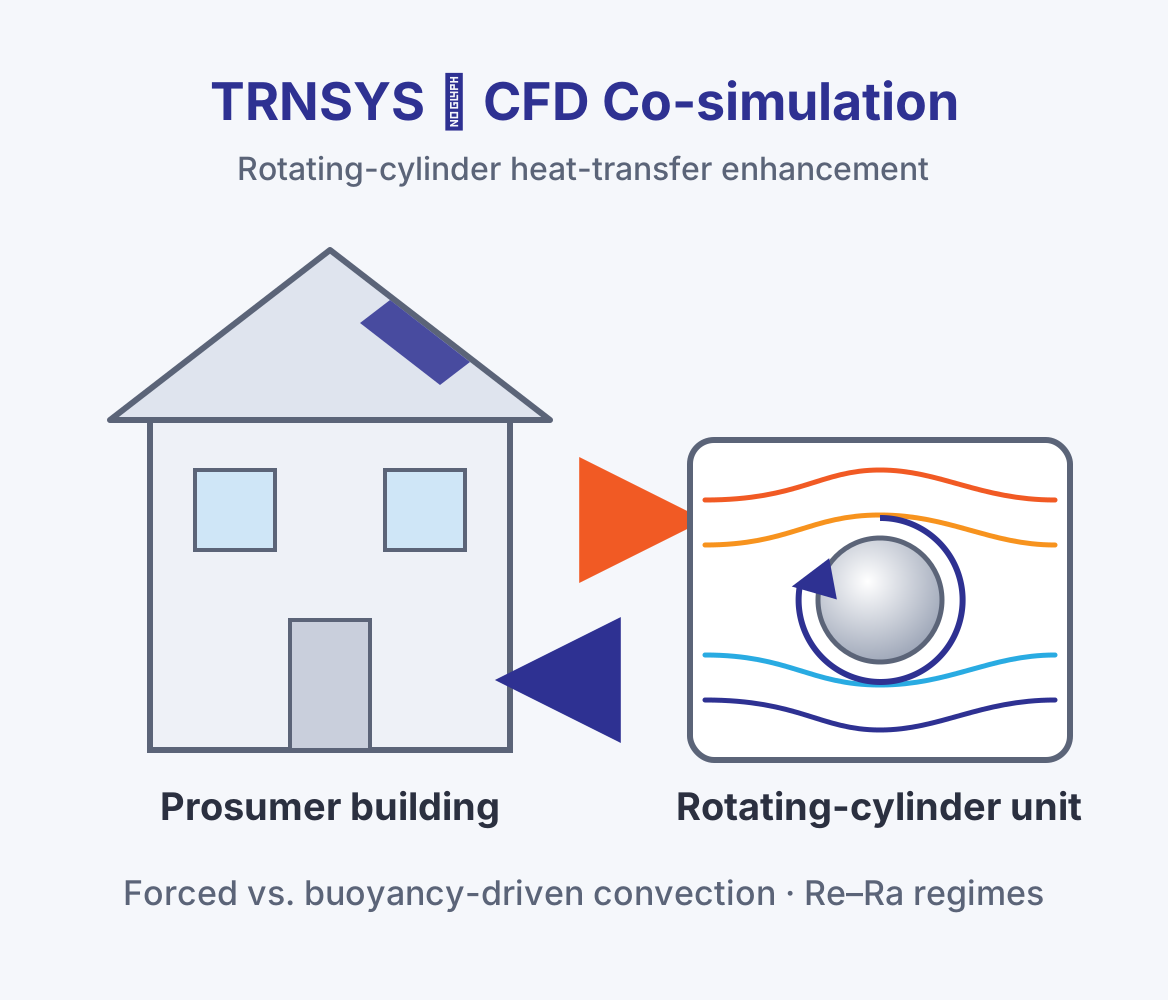
Rotating Cylinders for Prosumer-Building Thermal Management
Applied Thermal Engineering · 2026
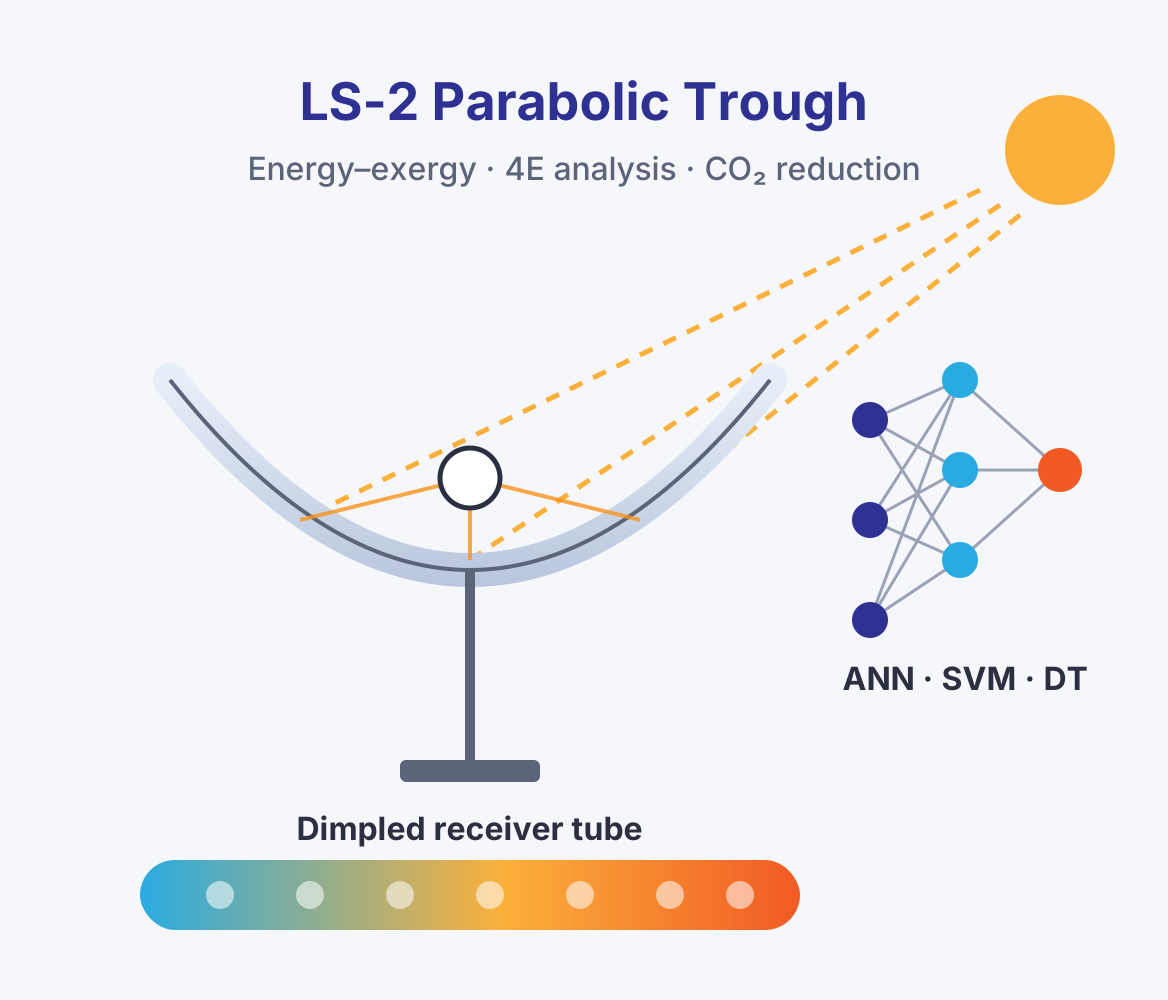
Energy–Exergy Assessment of an LS-2 PTSC with Dimpled Receiver
Applied Thermal Engineering · 2026
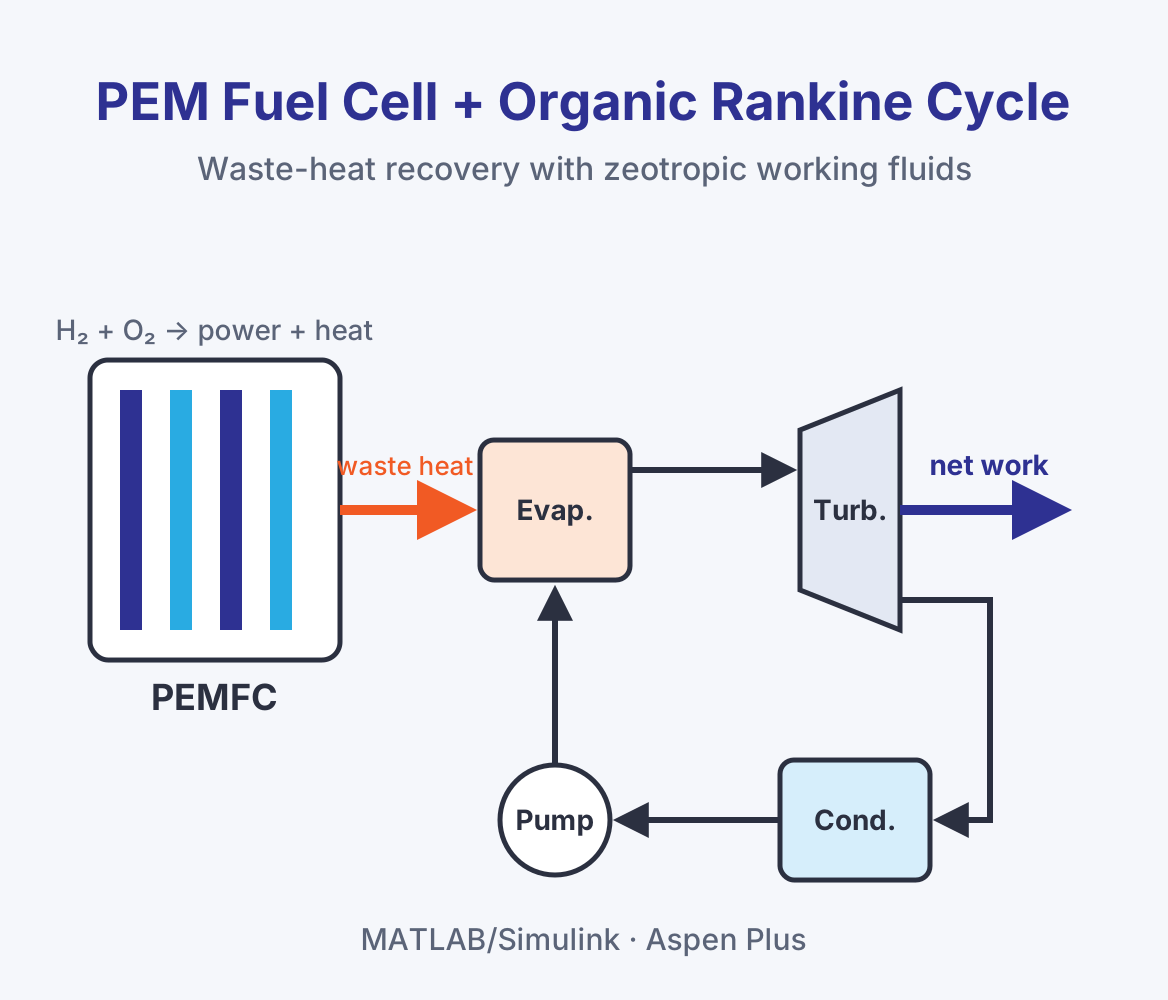
PEM Fuel Cell with Integrated ORC System
AIP Conference Proceedings · 2026
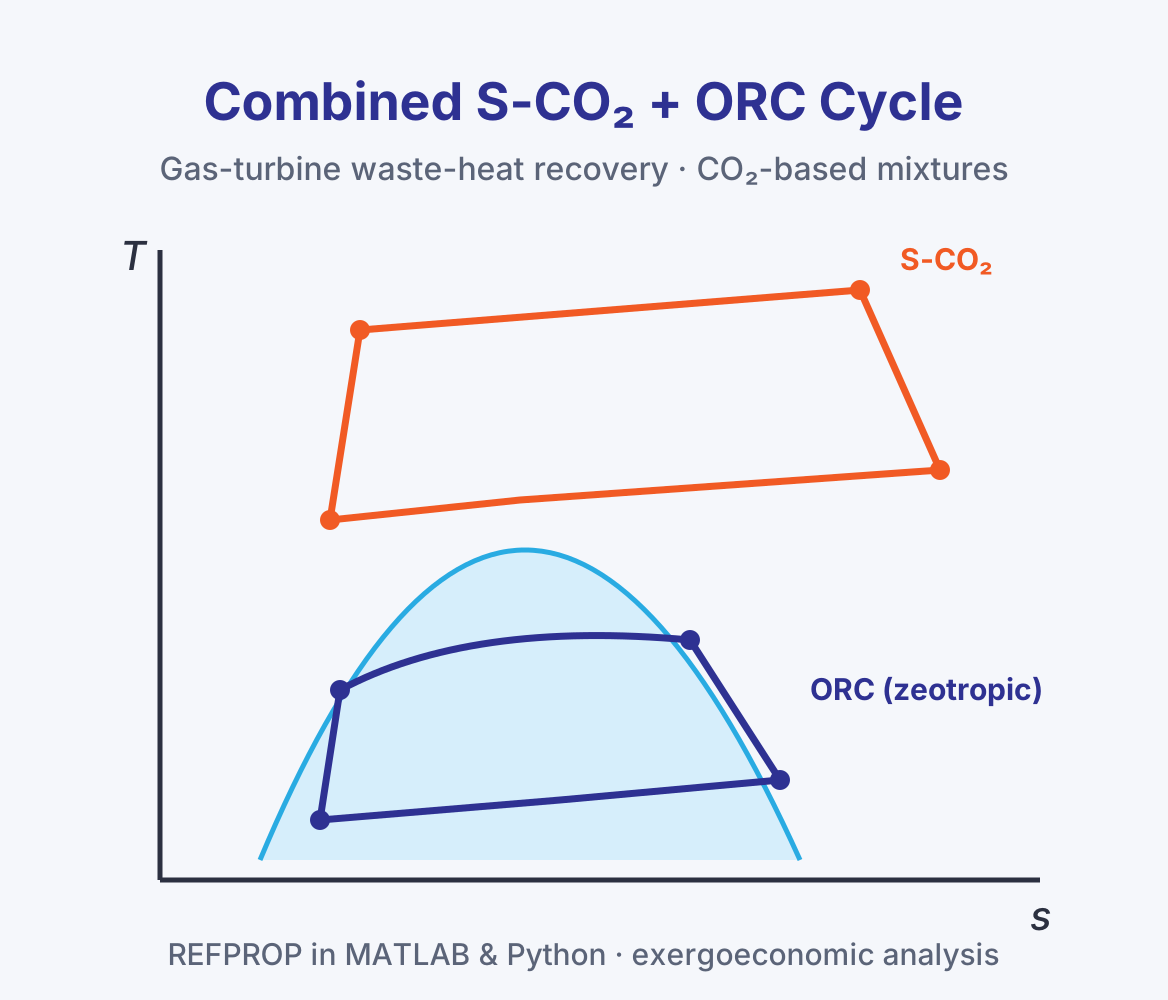
Combined S-CO₂ & ORC Cycle for Gas-Turbine Waste Heat
Research project · Thermodynamics
Coronavirus Dispersion in an Elevator
Biomedical CFD · Particle transport
COVID-19 Airborne Risk in a Classroom
Biomedical CFD · Indoor air quality
Aorta: Non-Newtonian Pulsatile Blood Flow
Biomedical CFD · Hemodynamics
Lumen Blood Vessel: FSI & Non-Newtonian Flow
Biomedical CFD · Fluid–structure interaction
Journal article · 2026
Auxiliary dual-mode rotating cylinders for energy-efficient thermal management in prosumer buildings: A coupled TRNSYS–CFD investigation
Journal
Applied Thermal Engineering (Elsevier)
Volume · Article
287 · 129558 (2026)
Author position
3rd of 5
Summary
Evaluating active heat-transfer-enhancement devices in buildings has been limited by a modelling gap: CFD is needed to resolve the local flow inside the unit, while annual performance needs whole-building simulation. This study closes that gap with a coupled TRNSYS–CFD co-simulation framework for a dual-mode rotating-cylinder unit serving a multi-purpose prosumer building.
The coupled model reveals distinct seasonal thermofluid regimes. In winter, Reynolds and Rayleigh numbers must be tuned together to avoid buoyancy-driven performance loss. In summer, the system sits in a low-Rayleigh regime where forced convection alone controls performance. These findings form the basis of a season-adaptive control strategy.
Key findings
- Up to 24.8% heat-transfer enhancement from the rotating cylinder unit.
- Heating and cooling loads reduced by 3.1% and 6.9%, giving a 3.5% cut in total energy use and 2.8% lower CO₂ emissions.
- About 30% lower computational cost than a DesignBuilder simulation of the same building.
My contribution
- Developed the coupled TRNSYS–CFD co-simulation framework used to evaluate the active heat-transfer-enhancement device.
- Performed the seasonal thermofluid analysis under forced and buoyancy-driven convection regimes.
- Quantified heat-transfer enhancement, energy savings and CO₂ reduction under optimised operating conditions.
Methods & tools
- CFD
- TRNSYS
- Co-simulation
- Mixed convection
- Rotating cylinders
- Building energy
How to cite
Stojanovic, A., Yeung, C. S., Arif, M. A. R. B., Sedaghat, M., & Zheng, Q. (2026). Auxiliary dual-mode rotating cylinders for energy-efficient thermal management in prosumer buildings: A coupled TRNSYS–CFD investigation. Applied Thermal Engineering, 287, 129558. https://doi.org/10.1016/j.applthermaleng.2025.129558
Journal article · 2026
Energy–exergy assessment of LS-2 PTSC with dimpled receiver for CO₂ emission reduction: Machine learning algorithms
Journal
Applied Thermal Engineering (Elsevier)
Volume · Article
305 · 132971 (2026)
Author position
2nd of 4
Summary
A series-connected LS-2 parabolic trough solar collector system is assessed with seven receiver configurations using energy, exergy, enviroeconomic, exergoenvironmental and exergoenviroeconomic analyses. The study examines how dimpled receiver geometry and wind velocity affect thermal performance, exergy efficiency, Nusselt number, pumping power and the cost of CO₂ emissions.
Key findings
- The dimpled receiver consistently outperformed the plain receiver in both energy and exergy performance.
- It also delivered better environmental and sustainability outcomes, including CO₂ emission-related cost reduction.
- Of the three machine-learning models trained to predict receiver outlet temperature, the Artificial Neural Network was the most accurate.
My contribution
- Conducted the energy, exergy and 4E (enviroeconomic, exergoenvironmental, exergoenviroeconomic) assessment across the seven receiver configurations.
- Evaluated the effect of dimple geometry and wind velocity on efficiency, Nusselt number and pumping power.
- Applied ANN, Support Vector Machine and Decision Tree models to predict receiver outlet temperature.
Methods & tools
- Solar thermal
- Exergy analysis
- 4E analysis
- Heat-transfer enhancement
- ANN · SVM · Decision Tree
How to cite
Yeung, C. S., Arif, M. A. R. B., Stojanovic, A., & Kilic, G. A. (2026). Energy–exergy assessment of LS-2 PTSC with dimpled receiver for CO₂ emission reduction: Machine learning algorithms. Applied Thermal Engineering, 305, 132971. https://doi.org/10.1016/j.applthermaleng.2026.132971
Conference paper · Undergraduate thesis · 2026
A comprehensive analysis of PEM fuel cell with integrated ORC system
Published in
AIP Conference Proceedings 3488, 130001 (2026)
Conference
9th BSME International Conference on Thermal Engineering
Author position
1st author
Summary
Proton-exchange-membrane fuel cells reject a large share of their input energy as low-grade heat. This work develops a full thermodynamic and electrochemical model of a PEM fuel cell and couples it to an Organic Rankine Cycle that turns the waste heat into additional power. It was my undergraduate thesis at the Islamic University of Technology, co-supervised with Flinders University.
My contribution (first author)
- Built the thermodynamic and electrochemical PEMFC model in MATLAB/Simulink.
- Designed the ORC waste-heat recovery system in Aspen Plus.
- Compared zeotropic working-fluid mixtures to identify the most effective fluid for heat recovery.
- Carried out a sensitivity analysis of the fuel cell and an economic analysis using the best-performing mixture.
Methods & tools
- PEM fuel cell
- Organic Rankine Cycle
- Zeotropic mixtures
- Waste-heat recovery
- MATLAB/Simulink
- Aspen Plus
How to cite
Rafi, M. A., Islam, R., Shameer, N., Mahmud, M. A., Karim, M. R., & Bhuiyan, A. A. (2026). A comprehensive analysis of PEM fuel cell with integrated ORC system. AIP Conference Proceedings, 3488, 130001. https://doi.org/10.1063/5.0327703
Research project · Thermodynamics
Thermodynamic and exergy analysis of a combined supercritical CO₂ cycle and ORC for gas-turbine waste-heat recovery
Heat source
Gas-turbine exhaust
Analyses
Energy · Exergy · Exergoeconomic
Property data
NIST REFPROP
Implementation
MATLAB & Python
Overview
Gas turbines exhaust a large amount of high-temperature heat. This project designs a novel combined cycle that captures it: two supercritical-CO₂ (S-CO₂) cycles recover heat from the gas-turbine exhaust, and a bottoming Organic Rankine Cycle running on CO₂-based zeotropic mixtures recovers the remaining low-grade heat to raise overall efficiency.
Approach
- Modelled the complete gas-turbine, S-CO₂ and ORC system with real-fluid properties from the REFPROP library, implemented in both MATLAB and Python.
- Carried out a complete thermodynamic analysis, an exergy analysis to locate irreversibilities, and an exergoeconomic analysis to link those losses to cost.
- Used CO₂-based binary zeotropic mixtures in the ORC, whose temperature glide better matches the heat source.
Skills developed
- Supercritical CO₂ cycles
- ORC design
- Exergoeconomics
- REFPROP
- Python
- MATLAB
Biomedical CFD project
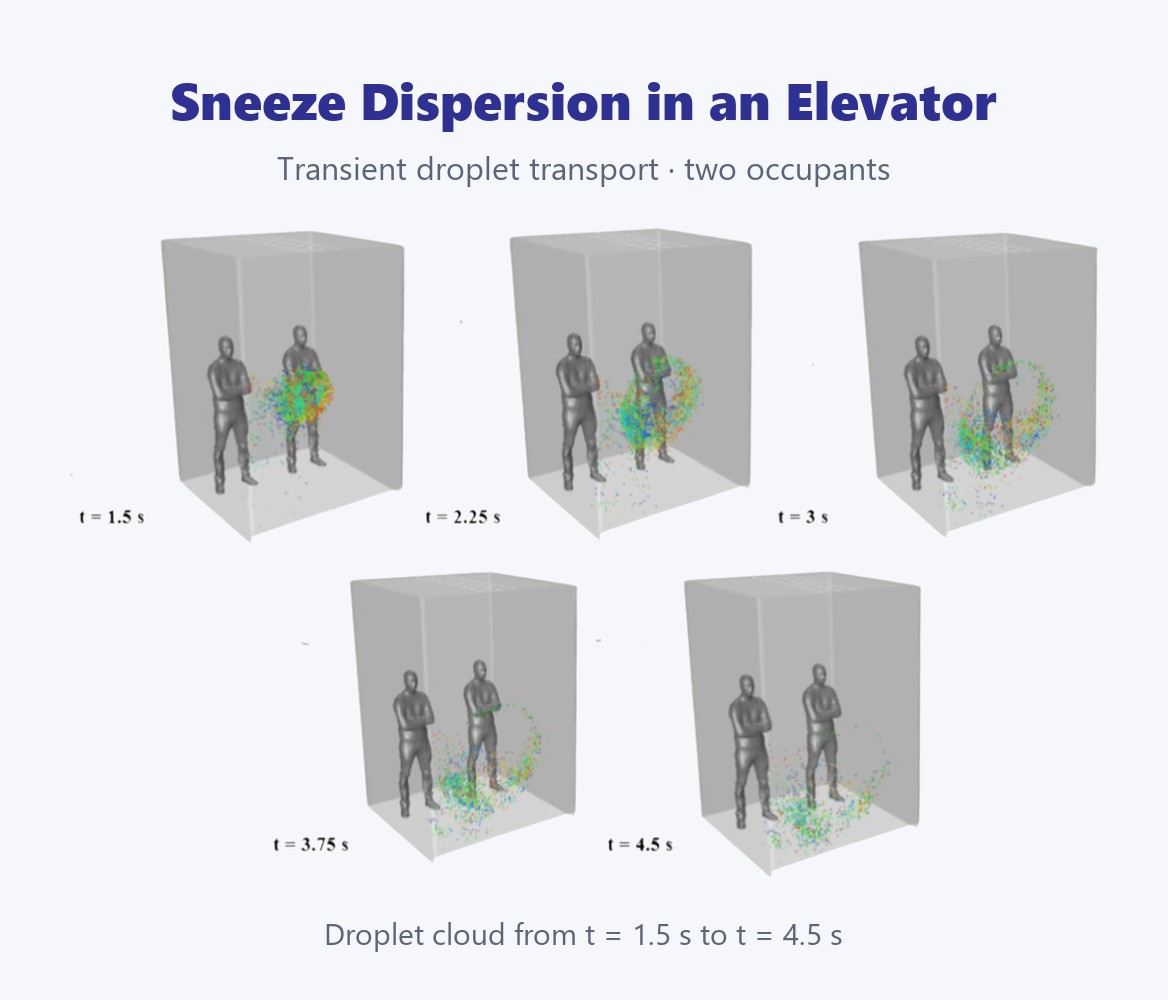
Coronavirus Dispersion in an Elevator due to a Sneeze
Flow type
Transient, droplet-laden air
Domain
Elevator cabin · two occupants
Overview
Objective
Understand how quickly virus-laden droplets from a single sneeze reach another person in a small, enclosed space, and where they end up.
Approach
A 3D transient simulation of an elevator cabin with two standing occupants. The sneeze is released as droplets that are tracked individually through the cabin air over time.
What it shows
By t = 1.5 s the droplet cloud has already reached the neighbouring occupant. Over the next three seconds it spreads, loses momentum and settles toward the floor. The result illustrates why short distances offer little protection in small enclosed spaces.
Skills developed
- Transient simulation
- Droplet / particle tracking
- Meshing human geometry
- Time-resolved post-processing
Biomedical CFD project
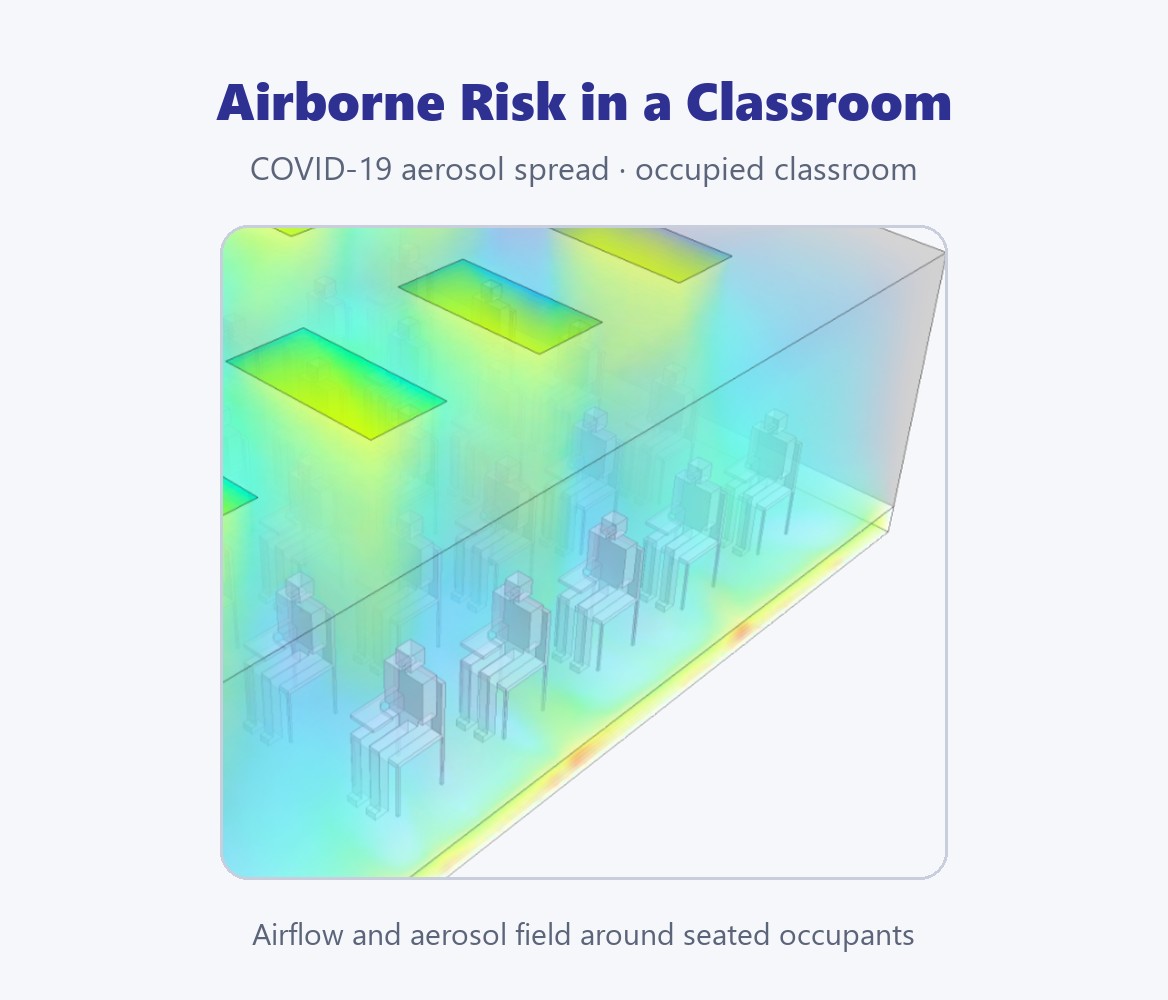
COVID-19 Airborne Risk Measurement in a Classroom
Flow type
Indoor airflow & aerosol transport
Domain
Classroom · seated occupants
Overview
Objective
Assess where exhaled aerosols accumulate in an occupied classroom, and how that affects each student's exposure to airborne infection.
Approach
A 3D model of a classroom with rows of seated occupants and the room's ventilation layout. The airflow and aerosol field were solved throughout the room and visualised as a volume contour.
What it shows
Aerosol concentration is far from uniform: it varies strongly between the ceiling, the breathing zone and the floor, and from seat to seat. Ventilation layout, not just occupancy, determines who is most exposed.
Skills developed
- Indoor air quality
- Aerosol / species transport
- Ventilation analysis
- Exposure-risk assessment
Biomedical CFD project
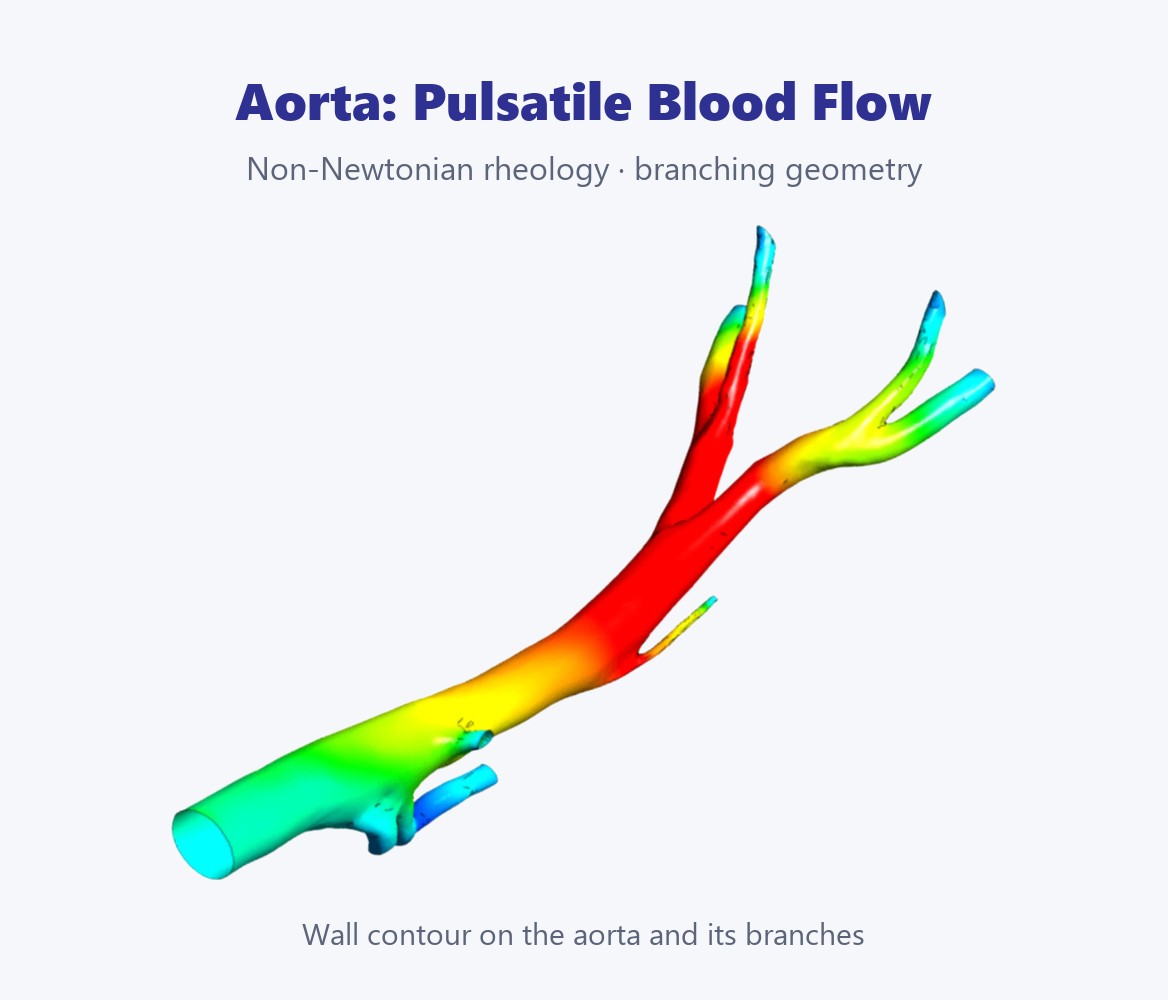
Aorta: Non-Newtonian Pulsating Blood Flow
Flow type
Pulsatile, non-Newtonian
Domain
Aorta with branching arteries
Overview
Objective
Capture realistic blood flow through the aorta and its branches over the cardiac cycle, where the constant-viscosity assumption breaks down.
Approach
An aortic geometry with its branching arteries, driven by a pulsatile (time-varying) inflow. Blood is modelled as a non-Newtonian, shear-thinning fluid whose viscosity depends on the local shear rate.
What it shows
The wall contour varies strongly along the vessel. Values peak in the main trunk and around the bifurcation, and fall toward the inlet and branch outlets, which are the regions that matter most in hemodynamic assessment.
Skills developed
- Non-Newtonian rheology
- Pulsatile boundary conditions
- Vascular geometry
- Hemodynamics
Biomedical CFD project
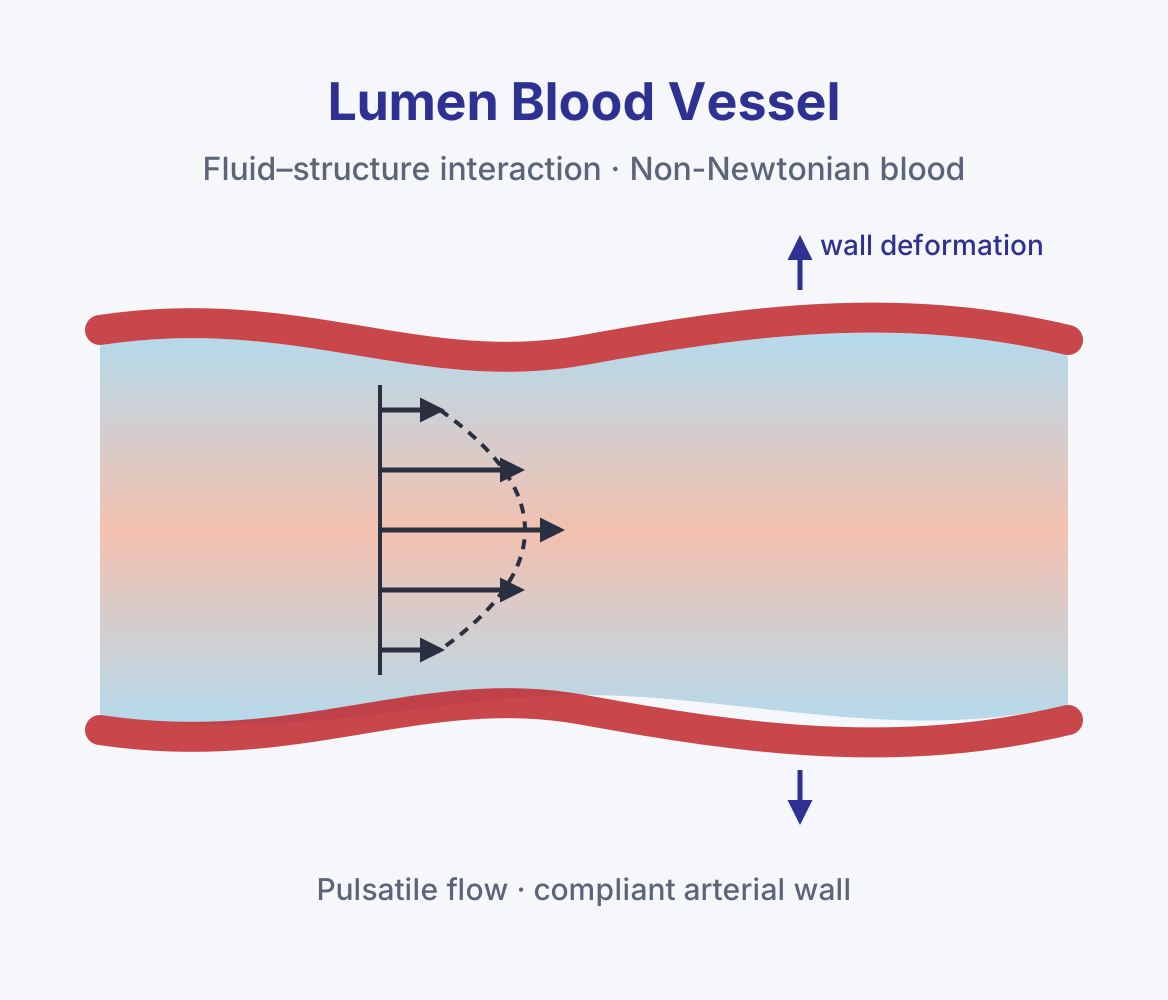
Lumen Blood Vessel: FSI & Non-Newtonian Flow
Flow type
Non-Newtonian blood flow
Coupling
Fluid–structure interaction
Overview
Objective
Study how blood flow and a flexible vessel wall affect each other, which a rigid-wall simulation cannot capture.
Approach
A fluid–structure interaction (FSI) simulation of a blood-vessel lumen. The flow exerts pressure and shear on the vessel wall, the wall deforms, and the deformed wall in turn changes the flow domain. Blood is treated as a non-Newtonian fluid.
Skills developed
- Fluid–structure interaction
- Coupled fluid & structural setup
- Non-Newtonian rheology
- Multiphysics CFD
Education
Teaching & Work
Technical Skills
Simulation, design and scientific-computing tools I use in research.

Ansys Fluent
CFD

OpenFOAM
CFD

CONVERGE
CFD

ANSA
Pre-processing & meshing
MATLAB / Simulink
Modelling

Aspen Plus
Process simulation

SOLIDWORKS
CAD

KeyShot
Rendering
Programming
- Fortran
- C
- C++
- Python
- MATLAB
High-Performance Computing
- MPI
- Parallel computing
- TTU HPCC
- TACC
- ORNL
Data & Modelling
- Machine learning (ANN · SVM · DT)
- REFPROP
- LaTeX
Honors & Certifications



Texas Tech
TTU Chaudhuri Designated Scholarship
Mechanical Engineering, Texas Tech University
2020 – 2024
OIC Scholarship
Organization of Islamic Cooperation, full B.Sc. program at IUT
Runner-up
TRACTION 2.0, Intra-IUT CAD Competition
Project Design segment, hosted by IUT CAD Society
2021 – 2024
SOLIDWORKS & 3DEXPERIENCE
CSWA (2021) · CSWP (2022) · CSWP-Drawing (2022) · 3DSwymer Associate (2024)
IELTS
Overall Band 7.5
Listening 8.5 · Reading 7 · Writing 7 · Speaking 7.5
Mentors & Collaborators
Researchers I have been fortunate to learn from and work alongside.


Co-supervised my undergraduate thesis on PEM fuel cell waste-heat recovery with an Organic Rankine Cycle, which was published in AIP Conference Proceedings.
Prof. Md. Apel Mahmud
Flinders University, Australia

Undergraduate thesis supervisor at IUT, guiding the thermodynamic modelling and analysis of the PEMFC–ORC system.
Prof. Arafat A. Bhuiyan
Islamic University of Technology

Undergraduate thesis co-supervisor at IUT and co-author on the PEMFC–ORC conference paper.
Prof. Md. Rezwanul Karim
Islamic University of TechnologyGet in Touch
I'm always happy to talk about turbulence, CFD, high-performance computing or potential research collaborations. Email is the best way to reach me.
-
Email
mdaarif@ttu.edu -
Phone
+1 (806) 577-6531 -
-